
Layher is recognized for precise multidirectional connections, consistent manufacturing, and strong dealer support. The brand suits contractors who invest for the long run and need stable, repeatable assemblies on complex geometry.
Layher emphasizes accuracy and lifecycle value. Connection geometry supports complex façades, curved runs and offsets, while certified components and a wide dealer network help maintain uptime on long programs.
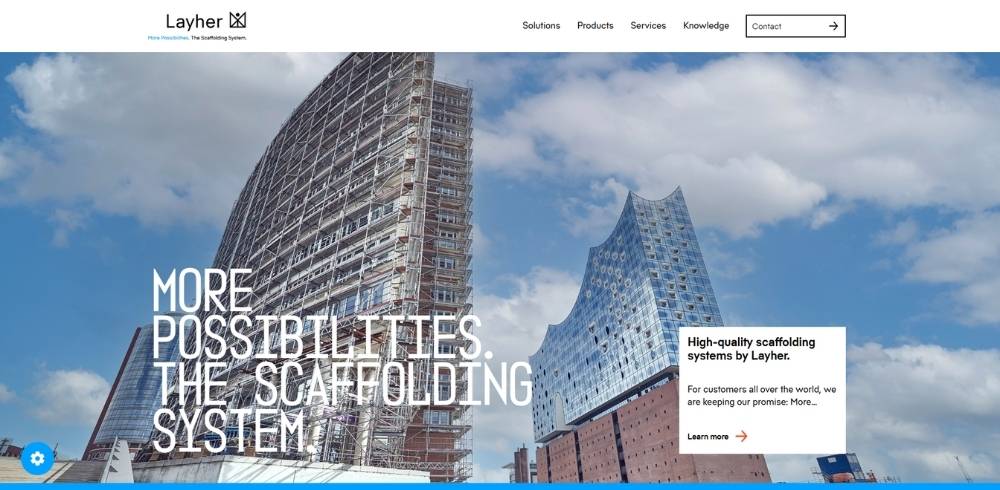
Why Layher is trusted for complex geometries
Tight tolerances and a broad ecosystem of accessories support predictable, repeatable assemblies.
Precision connections
- Multidirectional nodes handle angles, offsets and radius work.
- Consistent fit reduces cumulative error on large façades.
- Accessories complete safe decks, guard rails and stairs.
Fleet-friendly design
- Durable components maintain value through multiple projects.
- Dealer network eases parts replacement and expansion.
- Documentation supports inspection and handover routines.
Systems, documentation and method
Main product families
- Multidirectional modular scaffolding for complex shapes.
- Façade lines with integrated internal access options.
- Access stairs and platforms for staged renovations.
Technical documentation
- Assembly guides with clear node orientation.
- Inspection records and maintenance guidance.
- Compliance files aligned with European practice.
Strengths
- High precision for difficult façade geometry.
- Reliable dealer network and certified components.
- Strong resale value over the lifecycle.
Points to consider
- Higher acquisition cost than mid-range systems.
Logistics and after-sales
Parts & continuity
Certified parts are widely distributed through dealers, simplifying replacements and extensions during long projects without breaking assembly consistency.
Support in the field
Practical guidance focuses on node orientation, tie patterns and safe internal travel, helping crews keep quality consistent across phases.
Who benefits most from Layher
Ideal user profiles
- Contractors managing complex façade geometry.
- Companies building premium, long-term fleets.
- Renovation teams needing predictable repeat setups.
Typical scenarios
- Curved or offset façades requiring precise nodes.
- Multi-phase building envelopes with staged access.
- Sites that value future resale and component longevity.
The comparator score reflects precision, network coverage, documentation clarity and lifecycle economics.
Practical questions
Is Layher suitable for highly irregular façades?
Yes. Multidirectional nodes allow fine control of angles and offsets, supporting consistent decking across irregular lines.
How easy is it to replace or expand components mid-project?
The dealer network provides certified parts with predictable lead times, keeping continuity when layouts evolve.
Why do fleets retain their value?
Dimensional consistency and durable finishes help preserve component integrity, supporting strong resale over time.